
English 


Views: 0 Author: Site Editor Publish Time: 2026-07-03 Origin: Site


In critical care, the margin for error during continuous intravenous infusion is razor-thin. This proves especially true for drugs featuring short half-lives where ultra-low flow rates (e.g., < 1.0 mL/hr) are required. Even minor delivery inconsistencies can trigger rapid hemodynamic instability. We observe this frequently in fragile populations like neonates or adult patients relying on strong vasoactive support. An unexpected drop in drug delivery might collapse a carefully balanced blood pressure instantly. This article provides a rigorous, evidence-based framework for evaluating modern infusion systems. We will explore how an advanced ICU Syringe Pump manages the complex mechanical and fluidic challenges of ultra-low flow delivery. You will learn to navigate the intricate physics behind these life-saving devices. By understanding these technical variables, clinical teams can make much safer equipment decisions.
Flow Continuity Over Averages: A pump’s average accuracy over an hour is less critical than its minute-to-minute flow continuity (minimizing pulsation).
The Startup Delay Risk: Time-to-steady-state at low flow rates can take hours if not managed by advanced pump mechanics and proper priming protocols.
Consumable Variables: Syringe size, plunger stiction, and in-line IV filters drastically alter pump performance, regardless of the pump's native software precision.
Procurement Standard: Reliable evaluation requires assessing performance against stringent compliance standards (e.g., IEC 60601-2-24) using trumpet curve analysis.
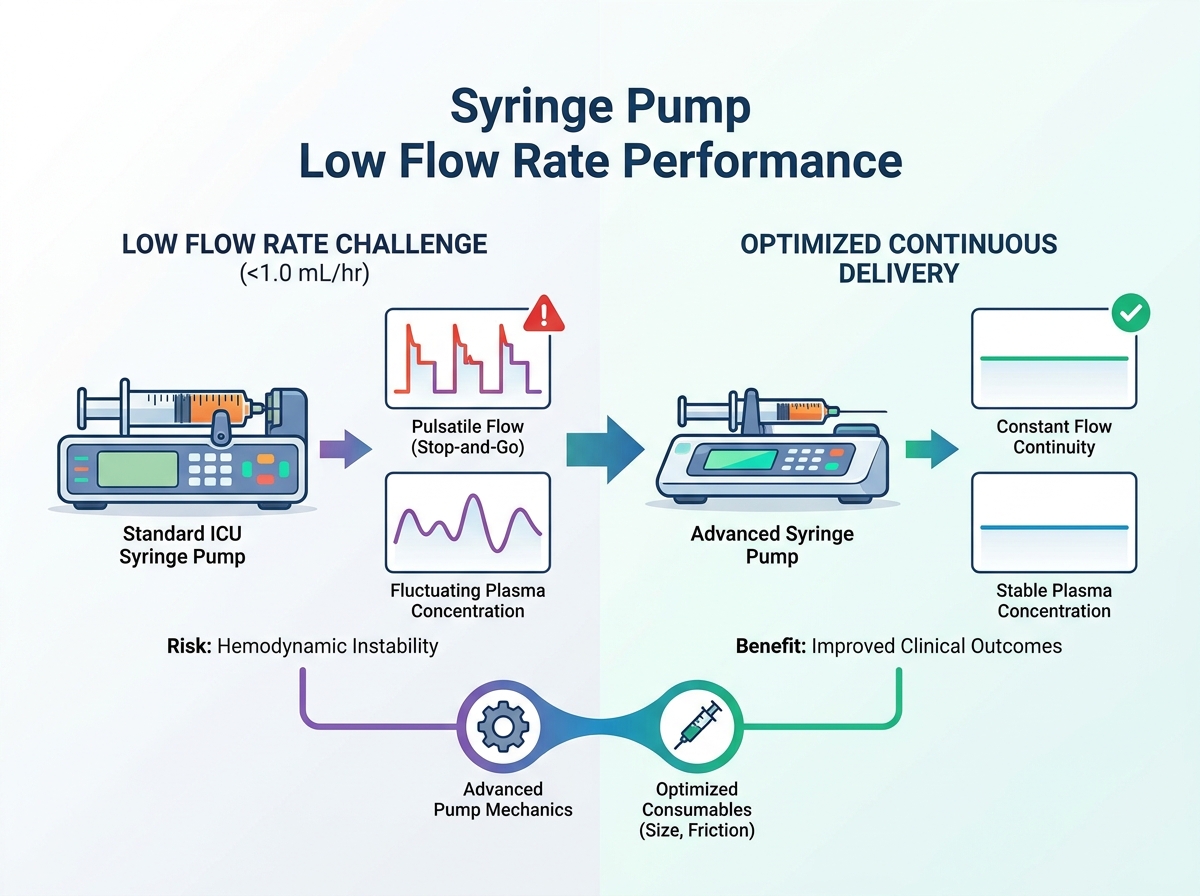
Delivering highly concentrated, fast-acting drugs at ultra-low speeds exposes dangerous mechanical vulnerabilities in standard infusion systems. Medications like norepinephrine or epinephrine possess extremely short biological half-lives, sometimes lasting only two to three minutes. When you administer these potent medications, tiny volume changes impact the patient instantly. Unfortunately, standard pumps often struggle to push fluids smoothly at rates below 1.0 mL/hr. They push small bursts rather than generating a seamless stream.
We refer to this stop-and-go delivery pattern as flow pulsation. It occurs primarily because traditional stepper motors advance in discrete, rigid increments. At high speeds, these steps blend together smoothly. However, at very low speeds, the motor pauses significantly between steps. This creates a staggered delivery profile. Consequently, blood plasma concentrations fluctuate wildly. A patient might experience dangerous hypertension during a micro-bolus. Moments later, they might face severe hypotension during the motor pause.
Another massive clinical challenge involves the startup delay gap. It takes considerable time for the system to achieve a steady-state delivery. Mechanical slack exists within the internal drive mechanism. Furthermore, tubing and syringe plungers compress slightly before any fluid actually moves. This system compliance delays the arrival of medication to the patient’s bloodstream. Without active management, a highly critical drug might take an hour to reach the patient. During this gap, clinical teams often mistake the lack of physiological response for an inadequate dose, prompting them to dangerously increase the infusion rate.
You must understand trumpet curves to evaluate flow accuracy properly. These standard graphs plot maximum and minimum percentage errors against varying observation windows. Short-term observation windows (e.g., 2 or 5 minutes) expose underlying pulsation risks. Long-term windows display the overall average accuracy. An unreliable device might show perfect average accuracy over an hour while failing miserably during a two-minute window. You should demand total transparency from vendors regarding these observation windows.
The internal drive mechanism strictly dictates flow smoothness. Standard stepper motors inevitably cause distinct pulses at low speeds. To eliminate low-flow pulsation, micro-stepping stepper motors are absolutely non-negotiable. Some premium systems utilize continuous linear actuators instead. These advanced technologies break down a single motor step into thousands of microscopic movements. They ensure the plunger moves continuously. When evaluating an ICU Syringe Pump, assessing motor resolution reveals its true capability for neonatal applications.
Detecting blockages remains incredibly difficult when fluid flow is minimal. Pressure builds very slowly at 0.5 mL/hr. If an occlusion occurs down the line, the device might push against the blockage for hours before triggering an alarm. Meanwhile, the soft tubing swells like a balloon. When the blockage finally clears, the stored fluid rushes into the patient as a massive, lethal bolus. Therefore, high-sensitivity inline pressure sensors are essential. They monitor subtle pressure trends actively and alert staff before dangerous bolus build-ups occur.
A strict inverse relationship exists between syringe diameter and low-flow accuracy. Larger syringes increase startup time drastically. They also decrease continuous flow precision significantly. A 50mL syringe features a large cross-sectional area. Therefore, a tiny motor step pushes a relatively large volume of fluid. Conversely, a 10mL syringe provides much finer fluid control. Clinical evidence consistently shows smaller syringes deliver vasoactive drugs much more safely.
Friction between the plunger and barrel creates sudden, uncontrolled micro-boluses. Engineers call this phenomenon stiction (static friction). As the plunger rests, it adheres slightly to the barrel wall. The pump motor builds up force slowly to overcome this resistance. Suddenly, the plunger jerks forward. This uncontrolled movement pushes an unintended bolus into the patient. Silicone lubricants inside the syringe can degrade during storage, worsening this erratic effect.
Secondary risks hide within your consumable sets. Soft tubing or in-line IV filters act as unintended compliance chambers. They expand slightly under system pressure. As the device advances, it fills this expanding space instead of delivering fluid to the patient. You must evaluate how much fluid these accessories absorb before true delivery begins. Rigid micro-bore tubing prevents this expansion and guarantees faster medication delivery.
Comparison of Syringe Sizes and Low-Flow Characteristics
Syringe Size | Cross-Sectional Area Impact | Estimated Startup Delay (at 0.5 mL/hr) | Pulsation Risk Level | Best Clinical Use Case |
|---|---|---|---|---|
50 mL | High volume per motor step | 45 - 60 minutes | Severe | High-volume hydration or nutrition |
20 mL | Moderate volume per motor step | 15 - 25 minutes | Moderate | Standard adult sedation |
10 mL | Low volume per motor step | 5 - 10 minutes | Low | Adult vasoactive drug delivery |
5 mL | Minimal volume per motor step | < 5 minutes | Very Low | Neonatal critical care |
You cannot rely solely on marketing brochures for performance claims. Any shortlisted device must clearly publish low-flow accuracy data per IEC 60601-2-24 standards. This international regulatory baseline provides a uniform testing environment. It mandates specific protocols for trumpet curve generation, backpressure testing, and alarm response times. Reviewing the IEC compliance documentation separates consumer-grade pumps from true clinical-grade life support equipment.
The device must scale seamlessly within complex hospital IT infrastructures. You should evaluate integration with Electronic Health Records (EHR). Can the software cross-reference low-flow drug libraries? Modern systems feature Drug Error Reduction Systems (DERS). An intelligent system warns users immediately if a programmed flow rate falls below the reliable threshold for the loaded syringe size. It establishes hard and soft limits, preventing a nurse from running a 50mL syringe at 0.1 mL/hr.
Procurement teams face a crucial choice between open and closed consumable ecosystems. Closed systems pair the hardware exclusively to proprietary syringes. They often guarantee superior low-flow performance by strictly controlling manufacturing tolerances and stiction profiles. Open systems, however, accept third-party consumables. While open systems offer supply chain flexibility, they require rigorous, hospital-led calibration. Your biomedical team must test and profile every third-party brand to ensure safe low-flow delivery.
Testing low flow performance locally prevents dangerous surprises on the ward. Before committing to procurement, establish a local simulation lab to verify manufacturer claims. Your clinical engineering team should lead this hands-on evaluation.
Mount the device securely on a stable IV pole to eliminate external vibrations.
Load your hospital’s exact standard-issue syringes (e.g., 10mL and 50mL variants).
Program an ultra-low rate, typically between 0.1 mL/hr and 0.5 mL/hr.
Connect the output directly to high-precision micro-balances equipped with evaporation traps.
Measure the real-time mass flow continuously over a mandatory two-hour window.
Map the exact startup delay and observe the micro-bolus variations precisely.
Technological accuracy easily unravels due to simple user errors. You need standardized clinical protocols for low-flow scenarios. Nurses must manually purge tubing to remove inherent mechanical slack. Proper priming eliminates trapped air and pre-tensions the internal drive mechanism. Without these crucial steps, even the most advanced stepper motor cannot overcome physical slack instantly.
Clinical directors and procurement teams must take decisive action. Request specific low-flow test data from manufacturers during the RFP process. Never accept blanket accuracy claims like "accurate to +/- 2%". Instead, demand raw trumpet curve graphs mapped specifically to your high-risk drugs. By centering physics and fluid mechanics in your purchasing logic, you protect the most vulnerable patients.
Evaluating an ICU syringe pump for low flow rates requires moving far beyond basic accuracy percentages. You must dive deeply into fluid mechanics, motor resolution, and complex consumable interactions. Average hourly accuracy means little if severe pulsation causes dangerous micro-boluses minute to minute. Decision-makers should prioritize flow continuity, micro-stepping capabilities, and rapid occlusion detection to safeguard high-acuity patients. Furthermore, establishing strict clinical protocols for purging and syringe selection ensures the hardware performs as intended. We highly recommend consulting a clinical engineering specialist before finalized purchasing. Ask vendors for technical data sheets and live demonstrations tailored expressly to neonatal or high-acuity adult care.
A: Minimum reliable flow rates depend heavily on the loaded syringe size. While some devices allow programming down to 0.01 mL/hr, achieving smooth delivery at 0.1 mL/hr typically requires a 10mL or smaller syringe. Using a 50mL syringe at such ultra-low rates poses severe clinical safety risks due to friction, stiction, and severe pulsation.
A: A trumpet curve visualizes flow deviations over specific time observation windows. It plots maximum and minimum percentage errors. Short observation windows (e.g., two minutes) expose dangerous short-term pulsation effects. Longer windows show overall average delivery accuracy. It provides a comprehensive, realistic picture of flow consistency.
A: Startup delay occurs due to mechanical slack in the drive mechanism and compliance in syringes or tubing. The system must compress these elements before fluid exits the needle. You can mitigate this dangerous delay by using strict manual or electronic purging functions. Pre-tensioning the system removes slack before connecting to the patient.
A: Yes, syringe brand significantly affects overall infusion accuracy. Manufacturing tolerances, internal barrel diameters, and plunger materials vary widely between different brands. These variations alter the physical resistance the motor encounters. Different friction levels directly impact stiction, startup time, and overall flow continuity at low speeds.


