
English 


Views: 0 Author: Site Editor Publish Time: 2026-11-03 Origin: Site


Imagine navigating the microscopic margins of a feline tumor excision. Suddenly, your field of view plunges into darkness the moment you lean over the operating table. Poor clinic lighting remains a notorious culprit behind chronic neck pain, severe eye strain, and compromised surgical precision. Integrating a specialized pet surgical headlamp with magnification loupes offers a profound ergonomic solution to these daily clinical struggles. In this comprehensive guide, we explore the transformative mechanics of surgical lighting. We will objectively weigh the pros and cons while providing a definitive buying checklist to help upgrade your clinic infrastructure.
Before diving into the detailed mechanics of veterinary illumination, understanding the core benefits is essential. The table below summarizes the primary advantages of upgrading your lighting system.
Core Benefit | Clinical Impact and Practical Application |
|---|---|
Ergonomic Relief | Pairing magnification loupes with a dedicated headlight promotes an upright neutral spine posture. This significantly reduces chronic back, shoulder, and neck pain for practitioners. |
Unmatched Precision | Advanced LED veterinary headlights eliminate shadows in deep anatomical cavities. They provide crisp coaxial illumination exactly parallel to where the surgeon is looking. |
Eye Health Preservation | Modern high-quality lighting systems actively reduce eye fatigue. They are engineered to be safe from ocular hazards by effectively filtering out harmful blue light spectrums. |
Smart Clinic Investment | Choosing the right equipment involves evaluating brightness, color temperature, battery life, and weight. Proper selection ensures a high return on investment through increased operational efficiency. |
Top Recommendation | Professional systems offer the ideal balance of lightweight design, intense illumination, and long battery life. They are essential tools for modern veterinary practices. |
The veterinary field has evolved dramatically over the past decade. Recent industry analyses highlight a massive surge in advanced specialized care. Pet owners increasingly expect human-grade medical interventions for their animals. Consequently, the demand for micro-vascular surgeries, advanced orthopedics, and complex endodontics has skyrocketed. Minimally invasive procedures require smaller incisions, which inherently restrict ambient light access. Relying on traditional room lighting is no longer viable for modern practices. Precision optics combined with targeted illumination now form the industry-standard baseline for delivering exceptional veterinary care.
Traditional operating rooms rely heavily on ceiling-mounted boom lights. These fixtures provide excellent broad ambient illumination across the surgical suite. However, they present significant physical limitations during intricate procedures. The primary issue is shadow generation. When a surgeon leans over the table to inspect a site, their head inevitably blocks the overhead beam. This casts dark shadows directly onto the critical tissue area.
A dedicated head-mounted light solves this fundamental physics problem through coaxial lighting. Coaxial illumination means the light source runs perfectly parallel to the user's line of sight. The beam originates exactly from between the eyes and travels along the exact visual path. Therefore, it becomes physically impossible for the surgeon's body to cast a shadow on the target area.
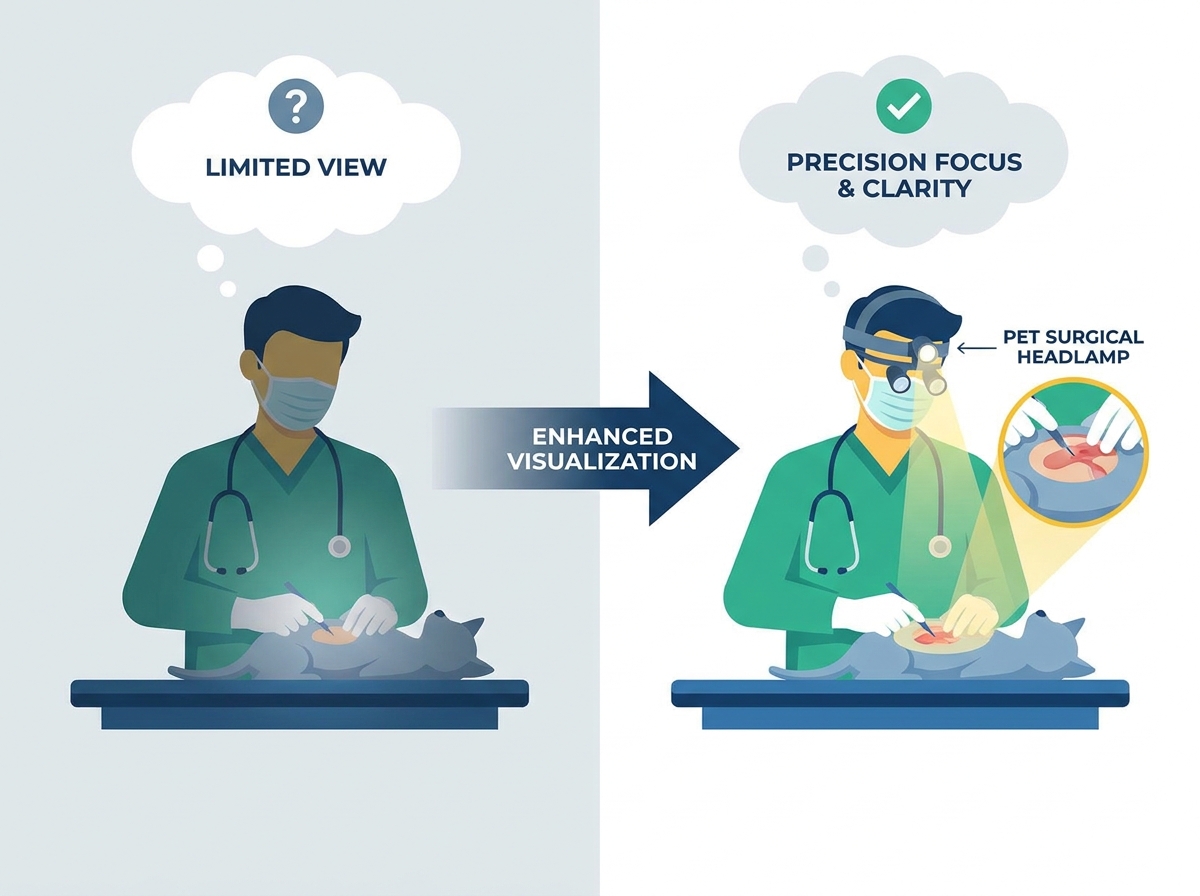
Investing in clinical-grade illumination impacts both the physical longevity of medical staff and overall patient outcomes. Here is an objective breakdown of the core benefits driving this technological shift.
Differentiating between healthy and necrotic tissue is paramount in veterinary surgery. Identifying minute blood vessels requires exceptional clarity. When a powerful LED light pairs with magnification loupes, visual acuity improves drastically. High-quality LEDs offer a high Color Rendering Index. A CRI above 90 reveals the true vibrant color of tissues. This rapid identification of anatomical structures significantly reduces accidental hemorrhage risks while improving overall surgical accuracy.
Musculoskeletal disorders remain a documented epidemic within the veterinary profession. Hours spent hunching over an operating table inevitably lead to career-shortening spinal injuries. Surgical loupes equipped with a properly angled headlight allow practitioners to maintain a healthy upright working distance. Keeping the head up and shoulders relaxed prevents cervical strain. Furthermore, the light automatically follows your gaze. You never need to contort your body to see into the surgical site.
Certain procedures are notoriously difficult to illuminate. Veterinary dentistry requires looking deep into narrow oral cavities to assess root health. Abdominal exploratory surgeries present similar spatial challenges. A premium veterinary pet surgical headlamp projects a focused intense beam directly into the line of sight. It penetrates deep narrow cavities without creating shadows from cavity walls or hands.
Operating in suboptimal lighting forces ciliary muscles to work harder. This visual overcompensation leads to asthenopia or severe eye strain. Symptoms often include tension headaches and extreme fatigue by the end of the shift. Bright focused LED light provides necessary contrast and clarity. Eyes remain relaxed. Reducing the visual effort required for micro-tasks helps maintain high concentration levels throughout complex procedures.
Taking a balanced objective approach is essential when evaluating medical equipment. Understanding both advantages and potential drawbacks helps clinic managers make informed purchasing decisions.
The advantages are substantial. Portability, intense brightness, and shadow-free coaxial illumination transform daily workflows. Modern systems are also highly adaptable. They mount easily to various surgical loupes or clear safety face shields. This versatility makes them invaluable for multiple practitioners sharing a single clinic space.
Early surgical headlamps had notable drawbacks. Fortunately, rapid technological advancements in micro-electronics have effectively engineered these issues out of existence.
Common Concern | Historical Drawback | How Modern Technology Solves It |
|---|---|---|
Weight and Discomfort | Early models used heavy halogen bulbs and bulky casings. This caused severe pressure on the nose bridge and neck pain. | Today's units utilize micro-LED technology and aerospace-grade aluminum. The lamp itself often weighs less than 15 grams, rendering it virtually unnoticeable. |
Cord Snagging | Traditional fiber-optic cables tethered the surgeon to a wall unit, creating dangerous trip hazards. | Modern systems use high-capacity lightweight lithium-polymer battery packs worn on the belt with ultra-thin wires. Fully wireless models are also widely available. |
Heat Generation | Halogen bulbs generated significant heat. This made the surgeon uncomfortable and risked tissue desiccation. | Advanced LED bulbs operate at exceptionally cool temperatures. They ensure absolute comfort for the surgeon and safety for exposed tissues. |
A valid safety objection regarding powerful LED lights involves potential impacts on long-term eye health. Addressing these concerns with scientific objectivity ensures safety for both practitioner and patient.
Commercial LEDs emit a spectrum containing significant blue light. Prolonged exposure to unfiltered high-intensity blue light associates with phototoxicity. However, medical-grade clinical lighting undergoes strict regulation. Professional optical engineering ensures emissions fall well below phototoxicity thresholds.
Veterinarians must verify their equipment integrates specialized ocular safety features. Reputable manufacturers build UV and blue light filters directly into the optical lens. Clinically approved units also feature adjustable intensity settings. Surgeons use only the exact amount of light necessary, protecting their own retinas and the sensitive eyes of anesthetized animals.
Procuring medical equipment requires careful evaluation of technical specifications against daily clinical realities. The chosen gear must be versatile, highly durable, and ergonomically sound. Here is an engineer-level checklist for selecting the optimal system.
The primary function of any surgical light is providing accurate visualization without causing glare. We measure this through Brightness via Lux and Color Temperature via Kelvin.
For general animal surgery, an optimal unit should deliver between 30,000 and 70,000 Lux at a standard working distance. High-quality systems feature stepless intensity adjustment. You can dial down brightness for reflective environments like scaling white enamel, then increase it for dark abdominal procedures. Prioritize a color temperature of 5000K to 6000K with a Color Rendering Index of 90 or higher. This specific range mimics natural daylight. It ensures red and pink hues of mucosal membranes render accurately, which is critical for assessing patient vitality during anesthesia.
Ergonomics extends beyond posture to include the physical burden of worn equipment. The biomechanics of the human neck dictate that frontal weight multiplies via the lever arm of head extension. Heavy units place continuous downward pressure on the nasal bridge.
Modern advancements have revolutionized material science in this sector. A top-tier pet surgical headlamp typically weighs under 15 grams excluding the battery pack. Aerospace-grade aluminum frames distribute weight evenly behind the ears, preventing micro-strain accumulation over a busy schedule.
Reliable power delivery is non-negotiable. A light dying mid-procedure poses a direct safety risk. Systems utilize advanced lithium-polymer technology configured in two primary ways.
Corded battery systems connect the LED module via a thin ultra-flexible cable to a larger belt-worn pack. Housing the battery externally keeps head weight to an absolute minimum. These robust packs provide 10 to 24 hours of continuous runtime. Conversely, cordless systems feature miniaturized batteries built directly into the frame. They offer total freedom of movement without wire management. The trade-off involves slightly more head weight and shorter runtimes requiring backup batteries for a full day.
Transitioning to a specialized magnification and illumination system represents a significant clinical upgrade. To maximize return on investment, managers should look for hardware that synthesizes all technical requirements seamlessly. When evaluating optical options, the ClearSight system consistently meets rigorous engineering standards. Designed specifically for animal healthcare demands, it provides an evidence-based solution to visual challenges faced in modern practices.
The system utilizes high-efficiency micro-LED technology designed to deliver consistent flicker-free illumination. It projects an intense uniform beam without hot spots that cause glare on wet tissues. Operating at the optimal daylight color temperature ensures subtle tissue variations remain immediately apparent.
Engineered from advanced composite materials, the light module minimizes nasal bridge weight. Furthermore, the lithium-polymer power bank features a constant-current drive. This engineering detail ensures light intensity will not slowly fade as the battery drains.
Veterinary surgery presents wildly unique spatial challenges. A doctor may perform a delicate eyelid mass removal on a terrier, followed immediately by deep orthopedic work on a mastiff. The articulated mounting hinge allows rapid adjustment of the coaxial angle. Whether looking down into a deep cavity or working superficially, the light tracks the exact visual path perfectly.
Advanced lithium-polymer batteries provide between 8 to 12 hours of continuous runtime on a single charge. High-capacity belt-mounted packs can exceed 15 hours. Runtime depends heavily on the intensity setting used. Running the light at maximum brightness drains the battery faster than a medium setting.
System compatibility is a standard feature in modern clinical lighting. Premium LED units come equipped with universal mounting clips designed to attach securely to the frame of almost any standard safety glasses. Manufacturers often provide custom bracket adapters tailored to specific Through-The-Lens loupe brands.
A magnification power of 2.5x to 3.0x is universally recommended for general procedures. This range utilizes Galilean optics to provide an exceptionally wide field of view and deep depth of field. The focused LED beam pairs perfectly with 2.5x magnification, easily covering the entire magnified field to ensure edge-to-edge clarity.
Infection control remains critical in veterinary environments. Clean the module using a soft lint-free microfiber cloth lightly dampened with an optical-grade cleaner. Avoid harsh solvents or abrasive materials that degrade anti-reflective lens coatings. Never submerge the light module or battery pack in liquid.
The choice depends entirely on practitioner workflow preferences. Cordless models offer ultimate mobility by eliminating cable snag risks on surgical tables. Corded models remove battery weight from the head, significantly reducing neck strain during long procedures while offering extended battery life.
Standard overhead lights project broad illumination from a fixed ceiling point, which inevitably creates shadows when the surgeon's head blocks the beam. Coaxial lighting mounts directly between the user's eyes. Because the light travels perfectly parallel to the surgeon's line of sight, it completely eliminates shadows, even inside deep anatomical cavities.
Veterinary dentistry requires meticulous precision in a highly confined, dark space. Magnification loupes enlarge the micro-structures of the teeth and gums, allowing practitioners to easily identify micro-fractures, subtle signs of periodontal disease, and retained root fragments that are nearly impossible to spot with the naked eye.
Investing in a quality surgical illumination system is not merely an equipment upgrade. It serves as a vital engineering control to protect your physical health and ensure the safety of vulnerable animal patients. Proper lighting transforms visually demanding surgeries into smooth precise clinical procedures. By eliminating shadows, reducing eye strain, and promoting ergonomic posture, the right tools empower you to deliver the highest standard of care.
Do not let outdated overhead lighting compromise your surgical precision or your spinal health. Evaluate your current clinic setup today. By integrating a professional-grade pet surgical headlamp from ClearSight, you secure a reliable, high-performance tool built for the rigorous demands of modern veterinary medicine. Visit ClearSight's official catalog to explore tailored illumination solutions and take the first step toward a healthier, more efficient practice.


