
English 


Views: 0 Author: Site Editor Publish Time: 2026-11-03 Origin: Site


Modern veterinary clinics and mobile practices face a continuous set of operational challenges. Chief among these are the constant struggle for adequate floor space and the severe physical toll associated with lifting heavy, anxious animals. Picture a frantic pet owner, a veterinary technician, and a pacing German Shepherd crowded into a compact examination room. In these moments, every square inch matters.
To address these pressing structural issues, the Foldable Elevating Pet Operating Table has emerged as a definitive engineering solution. It brilliantly bridges the gap between spatial efficiency and ergonomic design. Veterinary equipment has evolved significantly over the past decade. Today’s practices require versatile, durable, and modular furniture. You need equipment that optimizes workflow without compromising the clinical quality of animal care.
In this comprehensive guide, we will explore the core mechanical benefits of investing in these advanced treatment tables. We will dissect the engineering behind their operation and provide a detailed, spec-driven buyer’s guide. This will help clinic owners make an informed, evidence-based purchasing decision.
Space Optimization: Advanced folding mechanisms allow clinics to instantly free up valuable floor space. This makes them highly ideal for small examination rooms and mobile vet units.
Ergonomic Support: Integrated electric elevating features prevent severe back strain for veterinarians. You can adjust the surface to the optimal working height for each specific procedure.
Patient Safety: Low-clearance lowering capabilities allow large, senior, or injured pets to step onto the table easily. This effectively reduces anxiety and minimizes lifting injury risks for staff.
Multi-Functional Use: A premium adjustable unit serves as an examination, treatment, and surgical workstation all within a single footprint.
Long-Term Durability: High-grade models featuring 304 stainless steel construction offer superior hygiene, exceptional rust resistance, and simplified daily maintenance.
Smart Investment: Upgrading to adaptable tables strategically improves clinical workflow, supports staff retention, and enhances overall client satisfaction.
Recent market analyses reveal a distinct shift in veterinary facility design. Driven by surging commercial real estate costs and the rapid expansion of mobile care units, practice managers are aggressively moving away from static layouts. Why pay for a large room when a smart layout can do the same work in half the space?
Current trends heavily favor modular, multi-functional spaces. Adaptable furniture is no longer viewed as a mere luxury. It has become a fundamental operational necessity to maximize revenue per square foot. Consequently, stationary tables are increasingly viewed as restrictive bottlenecks, pushing the industry toward dynamic, adjustable alternatives that adapt to the practitioner, not the other way around.
At its core, this specialized piece of veterinary furniture is engineered to maximize both spatial efficiency and clinical functionality. It combines a robust, collapsible structural frame with a sophisticated electric linear actuator system. This specific engineering allows the unit to be folded flat for storage or transport. When deployed, the table surface can be raised or lowered seamlessly at the press of a foot pedal.
Typically, these tables are constructed from industrial-grade materials. The 304-grade stainless steel is the undisputed industry standard for the tabletop. This alloy is chosen for its exceptional load-bearing capacity. High-end models easily support dynamic weights exceeding 260 pounds. Furthermore, it offers absolute resistance to biological fluids, blood, and harsh chemical disinfectants.
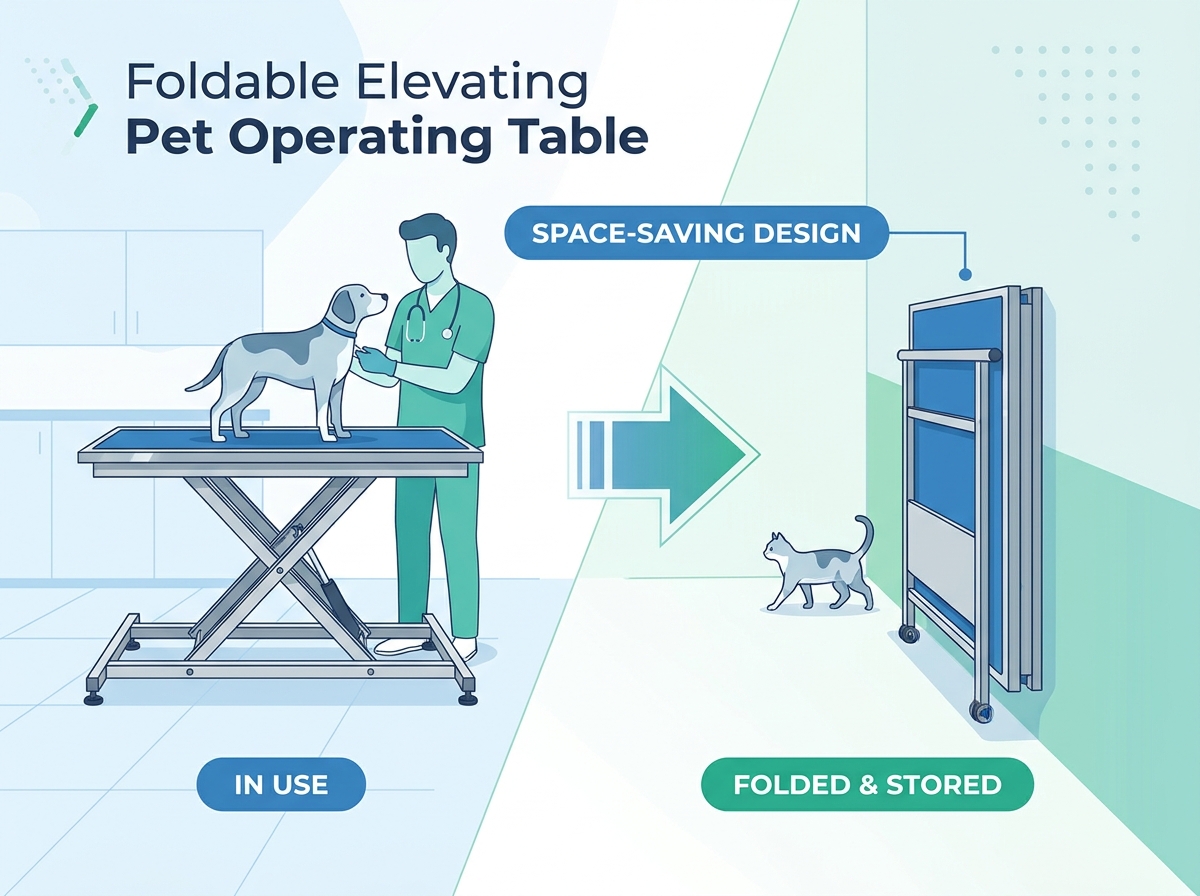
In the veterinary real estate market, square footage is an expensive premium. Many urban veterinary clinics operate with examination rooms that are highly compact. A bulky, stationary table bolted right in the center of the room makes the environment feel cramped. It restricts natural movement and subsequently elevates the stress levels of the animal.
A folding table provides an immediate structural solution. When the surface is not actively required for an elevated examination, the X-frame or scissor mechanism allows it to be seamlessly collapsed. You can tuck it away against a wall in seconds. This instantly opens up the room, providing ample floor space for observing a dog's gait or allowing a nervous pet to sit comfortably next to its owner.
The mobile veterinary sector has seen exponential growth. Practitioners are operating out of customized transit vans and RVs to make direct house calls. In these highly constrained environments, spatial efficiency is an absolute requirement. Mobile veterinarians benefit immensely from equipment that is structurally sturdy yet easily transportable.
A collapsible table can be securely stowed away during transit to maximize limited interior cargo space. Upon arriving at a location, the quick-release mechanism allows it to be deployed instantly. As a result, mobile vets do not have to compromise on the quality of their clinical setup. They can provide a stable, professional-grade examination surface anywhere.
To truly understand the operational impact, we must look at the data. Here is a direct engineering comparison between traditional static tables and modern adjustable units.
Operational Metric | Traditional Stationary Table | Foldable Elevating Table |
|---|---|---|
Space Utilization | Permanent footprint; blocks room flow. | Collapses flat; instantly frees up floor space. |
Ergonomics | Fixed height; causes chronic back strain. | Adjustable height; custom fits the veterinarian. |
Patient Access | Requires manual lifting of heavy animals. | Lowers to the floor; pets step on naturally. |
Hygiene Maintenance | Hard to clean underneath the base. | Folds away for complete floor sanitization. |
The physical demands of veterinary work are brutal. Veterinarians and technicians spend hours every day engaging in repetitive physical motions. Constant bending, leaning over fixed surfaces, and manually lifting uncooperative animals take a massive toll. Over time, these actions significantly contribute to musculoskeletal disorders and early professional burnout.
Integrating an elevating table directly addresses these occupational hazards. The ability to adjust the height precisely to the practitioner's stature is a critical ergonomic intervention. Whether you prefer to sit down for a meticulous dental cleaning or stand upright for a complex soft-tissue surgery, the equipment adapts to you. This prevents unnatural spinal curvature and protects your long-term physical health.
Modern elevating tables rely on advanced electric linear actuators. A defining characteristic of premium models is the integration of smooth, whisper-quiet motors operating under 50 decibels.
This technological refinement is crucial. Sudden, jarring movements or loud mechanical grinding noises will instantly startle an anxious animal. High-quality tables are engineered to transition between heights seamlessly. The gradual, controlled motion ensures the animal remains calm. Meanwhile, the veterinarian can make micro-adjustments to the working height via a foot pedal without breaking sterility or interrupting the procedure.
Manually hoisting an 80-pound Golden Retriever onto a standard 36-inch high examination table is dangerous. It poses a severe risk of spinal injury to the clinical staff. Furthermore, being lifted is a painful and highly traumatic experience for senior dogs suffering from osteoarthritis. The loss of footing frequently triggers panic and defensive bites.
To counter this, a stainless steel foldable elevating pet operating table drastically mitigates these risks through low-clearance capabilities. The electric lift can descend to within just a few inches of the clinic floor. Mobility-impaired pets simply step onto the surface under their own power. Once positioned, the table is gently raised. This aligns perfectly with Fear Free handling practices.
A common misconception is that folding equipment sacrifices structural stability for portability. In the context of professional veterinary medical equipment, this is entirely false. A wobbly surface will instantly induce panic in an animal patient.
Premium foldable tables are engineered with heavy-duty locking mechanisms, reinforced steel hinges, and robust X-frame bases. Once deployed and locked, the unit provides a rigid, wobble-free surface. It is functionally identical to a bolted stationary unit. Additionally, the stainless steel surfaces often feature subtle texturing or accommodate anti-slip mats to ensure secure footing.
Modern veterinary clinics design their floor plans to feature multi-use rooms. A single room may function as a consultation space in the morning, a triage area in the afternoon, and a minor surgical suite in the evening. The furniture within the room must be highly adaptable to keep up with this workflow.
A foldable elevating table excels here. Its adjustable height makes it perfect for routine vaccinations. When elevated and locked, it provides the rigid support necessary for precise wound debridement. High-end models offer the structural integrity required to serve as reliable operating tables for full surgical procedures.
The versatility extends well beyond basic lifting. Leading manufacturers design these units as comprehensive clinical workstations. They integrate a variety of specialized features directly into the frame.
Specifically, many models come equipped with built-in IV pole mounts. This allows for immediate fluid therapy administration without tripping over separate floor stands. Strategic drainage hooks and slight V-top surface designs facilitate fluid management during dental procedures. Integrated tie-down cleats provide secure anchor points for patient positioning during complex surgeries.
In any medical environment, stringent infection control protocols are non-negotiable. Veterinary surfaces are routinely exposed to biological fluids, sharp claws, and highly corrosive chemical disinfectants. The material composition dictates the table's lifespan.
This is precisely why top-tier equipment is constructed from 304-grade stainless steel rather than cheaper 201-grade alloys. The 304 alloy contains higher nickel content, making it exceptionally durable and inherently rust-proof. It is highly scratch-resistant and completely non-porous. Bacteria cannot penetrate the surface, making it impervious to contamination. It will survive years of harsh veterinary-grade sanitizers.
Maintaining a sterile clinic requires thorough cleaning protocols that extend beyond the tabletop. The physical footprint of traditional stationary tables creates blind spots underneath the base. Hair, blood, and biological debris accumulate unnoticed in these hard-to-reach areas.
In contrast, the foldable design offers a distinct clinical hygiene advantage. When the room requires deep cleaning, the table is simply collapsed and moved. This grants the janitorial staff completely unobstructed access to the floor space. The ability to easily sanitize the entire room significantly enhances the clinic's overall infection control efficacy.
When evaluating potential tables, the first technical specification to verify is the dynamic load capacity. Your equipment must safely accommodate the largest patients you expect to treat.
Look for a lifting capacity of at least 260 pounds. Check the specifications of the linear actuator. A robust motor ensures it can effortlessly lift giant breeds without burning out the internal gearing. A strong actuator guarantees the longevity of the lifting mechanism under heavy-duty daily use.
The primary appeal of a folding table is space-saving, but this is negated if the folding process requires two people and a toolbox. The design of the folding mechanism requires careful evaluation.
Clinic owners should look for tables that feature smooth-gliding tracks or easy-release pneumatic levers. The transition from a fully deployed state to a collapsed storage state should be intuitive. Equipment that is easy to manipulate ensures your staff will actually utilize the space-saving features during fast-paced shifts.
Investing in medical equipment is a significant capital expenditure. The reliability of the product depends entirely on the manufacturing standards. You must source equipment from established manufacturers known for rigorous quality control.
For instance, investing in a reliable Foldable Elevating Pet Operating Table from a trusted industry provider ensures you receive a product engineered for the rigors of veterinary medicine. Reputable suppliers use authentic 304 stainless steel, source durable medical-grade motors, and provide the necessary warranty support.
The evolution of veterinary clinic furniture has fundamentally improved how practitioners deliver care. The mechanical benefits of upgrading to a foldable, elevating table are clear. Space-saving design, ergonomic actuator support, improved patient safety, and hygienic 304 stainless steel durability demonstrate exactly why this equipment is the new standard.
This is not merely a cosmetic upgrade. It is a strategic investment in the occupational health of your staff and the safety of your patients. By reducing physical strain and minimizing animal anxiety, clinics foster a highly efficient healing environment.
We strongly encourage clinic managers to critically evaluate their current examination rooms. Consider how upgrading your static setups to premium foldable veterinary treatment tables can streamline your daily workflow, protect your dedicated team, and elevate your standard of care today.
Traditional stationary veterinary tables are typically fixed at a height of 35 to 36 inches. However, elevating tables offer a dynamic range, usually dropping as low as 10 to 12 inches for easy patient loading, and raising up to 39 or 40 inches to accommodate tall veterinarians during surgical procedures.
To clean a 304-grade stainless steel table, remove organic debris first. Then, apply a veterinary-grade quaternary ammonium disinfectant or a mild detergent. Avoid using harsh abrasive pads like steel wool, as they can scratch the finish and create micro-crevices where bacteria can hide. Wipe dry with a clean microfiber cloth to prevent water spots.
Commercial-grade tables built with heavy-duty steel frames and robust electric linear actuators can safely lift and support between 200 to 260 pounds. This high weight capacity ensures the motor can comfortably accommodate giant breeds like Mastiffs without straining the internal gears.
Yes, provided you purchase a premium engineered model. High-quality foldable tables feature reinforced X-frames, heavy-duty locking casters, and wide bases for center-of-gravity stabilization. Once locked into its upright position, it provides a rigid, wobble-free surface identical to traditional bolted tables.
No. Modern electric lift systems used in veterinary tables are sealed units designed to be virtually maintenance-free. The primary maintenance requirements are simply keeping the motor housing dry from clinical fluids, wiping down the exterior to prevent dust buildup on the actuator shaft, and inspecting the power cords.
Absolutely. Many foldable elevating tables are designed specifically with wet procedures in mind. They frequently feature built-in perimeter drainage troughs or slight V-top configurations. These designs channel water, blood, and ultrasonic scaler fluids away from the patient and into a collection bucket.
They are the optimal choice for mobile veterinary clinics. The interior of a mobile clinic van has strict spatial limitations. The ability of these tables to fold flat saves crucial floor space during transit. Furthermore, the electric lift brings professional, clinic-level ergonomics to remote driveways and house calls.


